
From the IBM 370 to AI Agents, Same Movie, New Special Effects
Discovering Why, Volume 6. Subscribe here for more.
Discovering Why, Vol. 5: The Surveyor’s Truth and the Stakes in the Dirt
Discovering Why, Volume 5. Subscribe here for more.Inside this Article... Introduction Starting at the Bottom With a Rod in My Hands Apprenticeship Is a Gift...
Discovering Why, Vol. 4: Discovering Why Moore’s Law is About Economics, Insights, and Removing Customer Constraints
Discovering Why, Volume 4. Subscribe here for more.Inside this Article... Introduction So I asked Gordon what he meant by “insight.” Here’s my private rule for...
Discovering Why, Vol. 3: Learning to Fly and Learning to Lead in Insights
Discovering Why, Volume 3. Subscribe here for more.Inside this Article... Introduction The Allure of the Runway Ground School and the First Reality Check...
Discovering Why, Vol. 2: What Do Clients Care About?
Discovering Why, Volume 2. Subscribe here for more.Inside this Article... Introduction Walking Into Len’s Office at Harris Interactive What This Has To Do With...
Introduction
Every once in a while, the past taps you on the shoulder and says, “Hey… you sure you’re not doing the exact same thing again?”
I’ve been feeling that tap lately. And if you lead insights, build insights tech, or depend on insights inside a brand, you probably have too.
Because your week sounds like this:
- “We need an answer by tomorrow. Also, can you make it global?”
- “Great deck. So what do we do?”
- “Can AI do this faster, safer, and cheaper, while also keeping Legal calm?”
Same pressure. New tools.

Back in the early 1980s, I was an IBM 370 operating system support programmer at Emory University, building and optimizing in Basic Assembler Language. That meant living in a world where “fast” and “painful” were separated by microseconds. When you made a mistake, it did not fail politely. It failed loudly. Like “why is the whole campus printing gibberish at 2:00 a.m.?” loudly.
Fast forward to today. Teams are racing to adopt generative AI, building agents, workflows, and new operating models for work that does not behave like neat input and output diagrams. Requests are messy. Priorities shift. Context arrives late or never. And the “user” might be a person, a system, another agent, or a Slack message that reads like a fortune cookie written by someone in a hurry.
Different era. Different tools. Same challenge.
How do you build an ecosystem that supports many users, many workflows, and many decisions, without turning into chaos with better branding?
The real parallel: ecosystems beat heroics
The IBM 370 was not one program. It was a platform that let many applications run at once, for many users, with sub-second response time. The OS work was not about building an app. It was about creating the conditions for all apps to succeed.
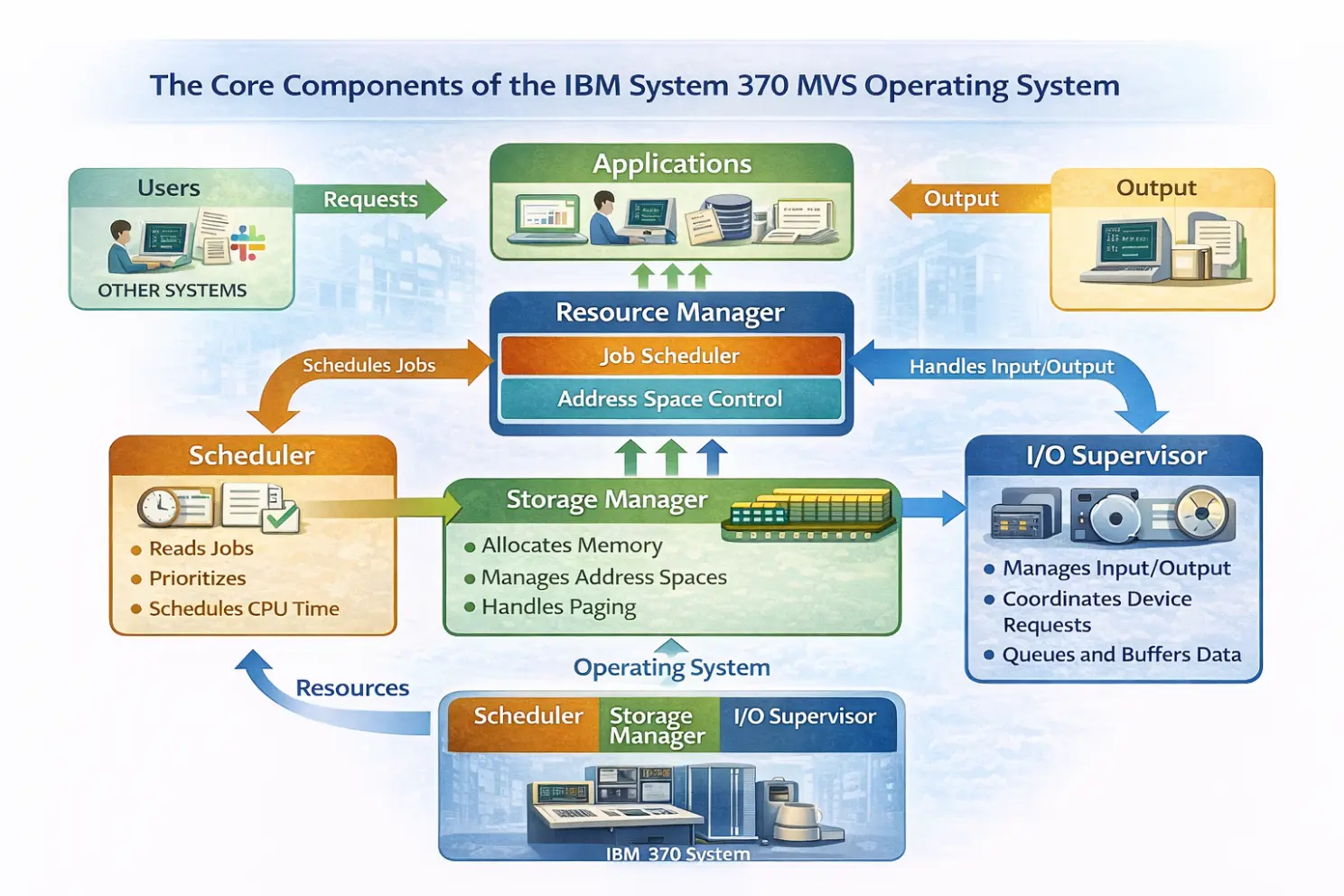
That required obsession over scheduling, prioritization, memory, I/O, and stability under unpredictable demand.
Sound familiar?
In 2026, we are trying to do the same thing, but the shared resource is not just computing. It is cognition. Models, context, tools, and trust.
The old question was: How do we allocate CPU, memory, and I/O across simultaneous workloads and still stay responsive?
The new question is: How do we allocate context, tool access, guardrails, and confidence across simultaneous requests and still deliver reliable outcomes?
Same game. New pieces.
Why things break: contention and variance
In the mainframe world, contention looked like memory pressure, CPU saturation, queue buildup, lock contention, and one runaway job consuming the world.
In the agent world, contention looks like tool bottlenecks, context overflow, duplicated work, runaway reasoning, quality collapse under volume, and hidden costs multiplying quietly.
The difference is that in the 370 era, you could see the system struggling in metrics and queues.
In the AI era, it is sneakier. The system still “runs,” but the output drifts, people redo the work, and leadership wonders why productivity did not magically double.
That is not a model problem. That is an ecosystem problem.

Four OS lessons that make AI relevant to brands and agencies
1) Scheduling becomes orchestration
On the 370, scheduling determined who got CPU time and when.
With AI, orchestration determines:
- which agent runs first
- which tools it can use
- when it should stop
- when it should hand off
- what gets escalated to a human
- what can be batched
- what needs immediate turnaround
Stakeholder translation: orchestration is the difference between “we acted in time” and “we got a deck after the decision.”
If you do not orchestrate, you do not have agents. You have a room full of talented interns shouting over each other.
2) Memory management becomes context management
Assembler teaches you respect because the machine punishes you instantly.
AI teaches you respect because it will confidently improvise when you forget to give it the right context.
Context discipline means:
- what does the agent need to know
- what can it fetch just in time
- what should be summarized
If you stuff everything into the prompt, you do not get intelligence. You get confusion with a larger invoice.
3) I/O optimization becomes tooling and data access
Back then, I/O was the bottleneck.
Today, the bottleneck is permissions, messy data, inconsistent definitions, noisy search, and workflows that require ten approvals to do one simple thing.
You can have the smartest agent in the world. If it cannot access the right data quickly and safely, it is a genius locked outside the building.
4) Reliability engineering becomes guardrails and observability
On big systems, you built monitoring, alerting, recovery routines, and predictable failure modes.
In AI terms, that becomes guardrails, evaluations, red-teaming, confidence thresholds, human review points, audit logs, and “why did it do that?” traces.
If you cannot observe it, you cannot trust it. If you cannot trust it, you will not scale it.

Agents that “think for themselves,” now add an octopus
Jonathan Brill and Stephen Wunker, in AI and the Octopus Organization, make a point that matters for every brand leader and agency builder: AI is not just a tool layer. It is an operating model redesign.
Their octopus metaphor works because it holds two truths:
- autonomy at the edges creates speed and relevance
- coordination across the whole organism prevents chaos
Here is the practical version.
Give each agent an “agent charter,” one page, six bullets:
- purpose and the decision it supports
- inputs and what “messy” looks like
- tools and data it can access
- guardrails, what it must never do
- escalation rules, when a human steps in
- definition of good, how you score quality
That is it. Enough structure to move fast without emailing 8,000 customers the wrong answer. Which is the modern version of printing gibberish at 2:00 a.m.
Discovering Why
We are at another inflection point where the nature of work is changing, not because people changed, but because the ecosystem did.
Back then… We worried about how do we let many users do many things at once without slowing down?
Now we are concerned with… How do we let many people and many agents do many kinds of thinking at once without losing trust, quality, or control?
The answer is not one model, one vendor, or one prompt.
It is the architecture of the ecosystem: how work is routed, how contention is managed, how reliability is proven, and how trust is earned.
You are not just adopting a tool.
You are building an operating system for decision-making.
Try not to print gibberish at 2:00 a.m.

Let's Work on Your Next Market Research Project
Get started with your next initiative
Follow
OvationMR



Resources
Calculators
Resources
Calculators
Visit Us:
- 101 Avenue of the Americas
- 9th Floor, Suite 908
- New York, NY 10013