
The Chronically Underserved Long Tail of Insights
Discovering Why, Volume 14. Subscribe here for more.
Discovering Why, Vol. 16: To Help Clients Find the Signal Amongst the Noise – Be the Signal in the Noise
Discovering Why, Volume 16. Subscribe here for more.Inside this Article... Be the Signal in the Noise Simplify without making things simplistic Democratize data...
Discovering Why, Vol. 15: Everything I Needed to Know About Working with AI Agents I Learned in Kindergarten
Discovering Why, Volume 15. Subscribe here for more.Inside this Article... The insights industry is not in decline. It is in redesign. We have been here before,...
Introduction
There is a part of the insights industry we do not talk about enough.
Not the global holding companies. Not the billion-dollar platforms. Not the consultancies with airports full of branded roller bags.
I am talking about the long tail of insights: the tens of thousands, and likely now more than 100,000 worldwide, of small and mid-sized specialist firms serving the real decision-making customer.

And by customer, I do not just mean commercial brands. I mean every organization trying to make better decisions in a noisy world: brands, nonprofits, government agencies, NGOs, universities, health systems, advocacy groups, public-sector institutions, and other organizations whose work depends on understanding people.
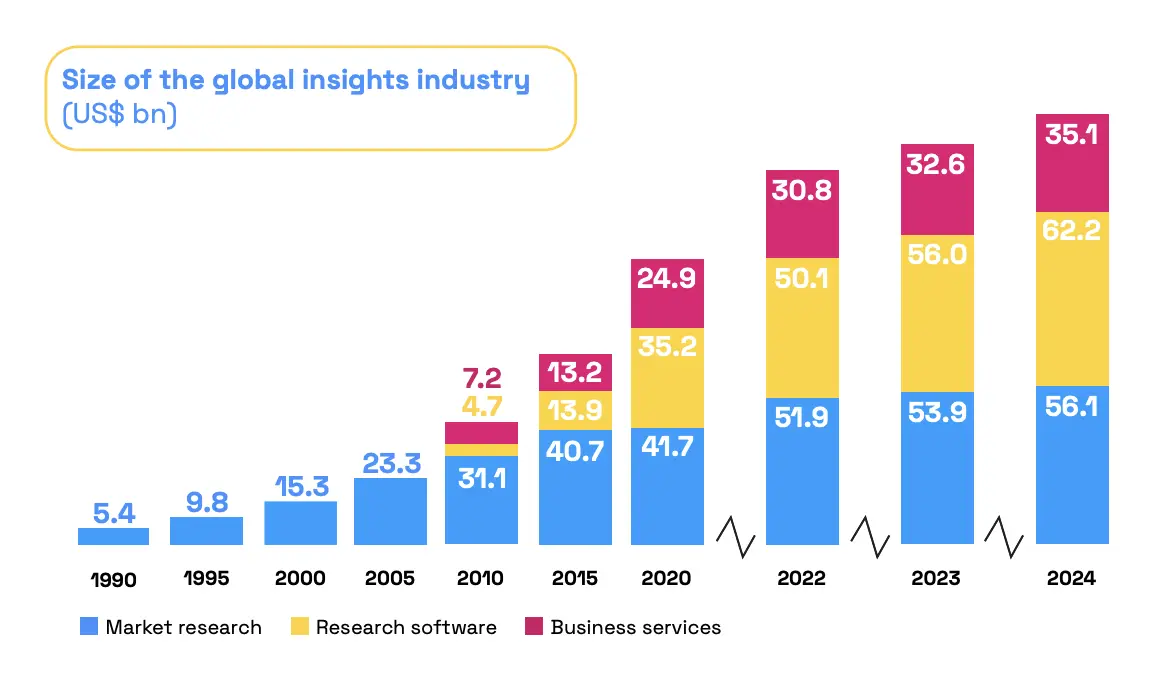
This is not a small corner of the economy. ESOMAR’s 2025 framing places the global insights industry at roughly $153 billion, and recent reporting on the U.S. insights and analytics sector puts that market alone at about $82.9 billion, growing 7.6% in 2024.
Yet inside this enormous marketplace, much of the practical, client-facing expertise sits outside the largest enterprise players. It lives in specialist firms that are closer to the customer, to the category, the community, and closer to the real decision-making questions.
These firms are not the industry’s leftovers.
They may be its most under-leveraged asset.
The organizations they serve are constantly asking versions of the same human questions.
What do people need? What do they believe? What are they afraid of? What would make them act? What would make them trust us? What should we build, change, communicate, stop doing, or do next?
That is the decision-making economy. And the long tail of insights is one of its most important, yet underserved, engines.
The irony is that many of these small and mid-sized firms are not small because they lack talent. Quite the opposite. They are often founded by people with deep domain expertise in healthcare, financial services, education, public policy, consumer behavior, product innovation, social impact, employee experience, brand strategy, and countless other specialized fields.
They know the client’s world. They know the language. They know the context behind the brief. They often understand the decision-making environment better than a much larger generalist provider ever could.
What they often lack is not intelligence, creativity, or credibility.
What they lack is scale.
Not scale in the “let’s become a giant” sense. Scale in the practical sense: reusable infrastructure, repeatable workflows, operational support, global audience access, marketing leverage, sales discipline, technology that compounds, and expert partners who help them say yes to bigger opportunities without becoming slower, heavier, or less human.
The long tail is not underpowered because it lacks expertise. It is underpowered because too much of the infrastructure around it was built for someone else.
The long tail does not need to become the big guys.
It needs scale without drag.

The Hidden Growth Trap
Many specialist insights firms start the same way.
A founder leaves a bigger company. A client follows. Then another client comes along. Suddenly, there is a business.
That first client or two may represent 80 or 90 percent of the revenue. The founder is busy. The team is busy. The work is good. The referrals are real.
But the business is fragile.
Delivery consumes the calendar. Deadlines crowd out business development. Marketing becomes something to “get back to.” Sales prospecting feels inconvenient compared with the urgency of today’s fieldwork, today’s analysis, today’s debrief, and today’s proposal revision.
Over time, the firm becomes excellent at serving the work it already has, but underpowered at creating the work it needs next.
That is the hidden growth trap of the long tail.
And it is not a character flaw. It is a structural problem.
The biggest firms in our industry have infrastructure. They have legal teams, finance teams, sales teams, marketing teams, procurement systems, global panels, proprietary platforms, data assets, and technology stacks that create economies of scale. They can absorb inefficiency. They can invest ahead of demand. They can build once and sell many times.
The smaller specialist firm usually cannot.
Instead, they rent capability one project at a time.
A survey tool here. A recruiting vendor there. A sample source for one audience. A dashboard platform for one client. A freelancer to clean up the deck. A scramble to find respondents. A scramble to manage fieldwork. A scramble to find the next thing that will get the project over the line.
The tools may be modern, but the operating model is still ad hoc.
And when every engagement becomes a custom assembly job, the firm loses the very thing it needs most: compounding advantage.
The issue is not access to tools. The issue is access to leverage.

When Infrastructure Becomes Drag
There is another layer to this problem that many independent insights operators know all too well.
Even when a specialist firm has its own preferred way of working, the client often dictates the tools, vendors, and platforms.
Use Qualtrics for the survey. Use Dynata for the sample. Use this dashboard. Use that procurement system. Use this compliance workflow. Use our approved vendor list.
On paper, this may look like standardization. And from the client’s point of view, it often makes sense. Large organizations want control, consistency, risk management, security, procurement simplicity, and internal compliance.
But for small and mid-sized insights firms, client-mandated infrastructure can quickly become a tax on speed, creativity, and responsiveness.
The problem is not that large platforms are bad. Many of them are very good at what they were designed to do. The issue is that they are often built around the needs of large enterprise buyers, not independent operators trying to deliver high-quality work with lean teams, tight timelines, and complex client expectations.
Enterprise platforms optimize for control. Long-tail firms optimize for responsiveness.
Enterprise procurement optimizes for standardization. Long-tail firms win through specialization.
Enterprise systems assume departments. Long-tail firms often operate through small, senior, hands-on teams.
When you force a specialist firm into infrastructure built for enterprise bureaucracy, you do not automatically create quality.
You often create friction.
And friction is expensive.
Every extra approval step, every slow response, every rigid workflow, every “submit a ticket and wait” moment steals time from the thing that actually creates value: helping the client make a better decision.
A platform is not a partner simply because it processes a transaction.
For the long tail, speed is not a luxury. It is part of the value proposition.
The client hired the specialist for judgment, context, and expertise. The operating system around that specialist should amplify those strengths, not bury them under process.

The Better Model: Dynamic Scale
What the long tail needs is not more process.
It needs more partnership.
It needs platforms, sample providers, audience partners, and operations companies that understand how specialist firms actually operate. Firms where the founder may still be writing the proposal, reviewing the screener, managing the client call, watching fieldwork, interpreting the data, and building the story all in the same week.
This is where smaller and mid-sized sample and operations partners can truly shine.
They can be closer to the operator. They can be more flexible. They can bring expertise, not just access. They can offer global audience reach without enterprise drag. They can scale up or down as the project needs change. They can adapt to the shape of the project rather than forcing the project into the shape of the system. They can solve problems in real time. They can behave less like vendors and more like partners.
This is what I call “dynamic scale.”
Dynamic scale means having access to the audience, operations, technology, and expertise you need when you need them, without the fixed costs, bureaucracy, or complexity of a much larger organization.
It is global audience access without enterprise drag. It is operational support without a bloated process. It is technology that accelerates work rather than becoming the work. It is expertise that shows up before the problem becomes expensive.
Dynamic scale is what allows a specialist firm to say yes to bigger opportunities without becoming slower, heavier, or less human.
Dynamic scale gives the long tail a way to grow without pretending to be something it is not.
Because the long tail does not need enterprise drag.
It needs an operating advantage.
Why This Matters Now
This matters because the long tail is not a marginal part of the insights economy. It is where much of the real specialization lives.
ESOMAR describes its Global Market Research report as an analysis of the size and characteristics of the broader insights industry, with a detailed view into the market research sector. That distinction matters because the world we serve is bigger than traditional research. It is the broader decision-making economy.
And this economy is changing quickly. Greenbook’s recent GRIT Business & Innovation work describes an industry in transition, where technology suppliers continue to surge while service-led firms face pressure from automation, self-serve models, and low-cost competitors.
That pressure is real.
But the answer for specialist firms is not to become cheaper, thinner versions of enterprise providers.
The answer is to become more focused, more leveraged, and more intentionally partnered.
These firms are close to the customer. They are close to the category. They are close to the community. They are close to the messy, qualitative, contextual, human reality of decision-making.
That closeness is valuable.
But closeness without infrastructure can become exhausting.
And exhaustion is not a strategy for growth.
Brands, nonprofits, government agencies, and NGOs are all under pressure to move faster, justify spending, show impact, understand more fragmented audiences, and make decisions in environments where attention is scarce and trust is fragile.
They need better listening systems. They need sharper interpretation. They need partners who understand the human context behind the data. They need insights providers who can move with urgency and still protect quality.
That is exactly where specialist firms can shine.
But only if they are not buried under the weight of their own delivery model.
The future will not reward the firms with the most disconnected tools. It will reward the firms with the smartest ecosystem.
The Next Right Step
The next right step for the long tail is not to add more tools.
It is to build a better-aligned ecosystem.
Choose sample, audience, operations, and technology partners who understand how expert-led firms actually work. Partners who bring global reach, operational discipline, flexible capacity, affordability, and real human expertise.
Stop treating these partners as project line items. They are the operating foundation for growth.
For some firms, that may mean rethinking the default choices. For others, it may mean building a bench of partners who are better matched to the way specialist firms actually work. It may mean choosing sample and operations partners not just because a client named them, or because they are the biggest, but because they bring the right combination of expertise, access, responsiveness, and flexibility.
The long tail should not have to apologize for needing a different model.
It should demand one.
Because the long tail is not underpowered because it lacks expertise. It is underpowered because too much of the infrastructure around it was built for someone else.
That can change.
The long tail has always had the expertise. Always had the client’s trust, and has always had a closeness to the real questions.
Now it needs the infrastructure to match.
Not bloated systems. Not one-size-fits-all platforms. Not process for the sake of process.
It needs dynamic scale: flexible, affordable, expert support that helps specialist firms grow without losing what made them valuable in the first place.
That is the next right step.
Build the ecosystem. Choose the partners. Create the leverage.
The long tail does not need to act like the giants to compete.
It needs scale without drag.
And with the right partners, that is exactly what becomes possible.

Let's Work on Your Next Market Research Project
Get started with your next initiative
Follow
OvationMR



Resources
Calculators
Resources
Calculators
Visit Us:
- 101 Avenue of the Americas
- 9th Floor, Suite 908
- New York, NY 10013