
Everything I Needed to Know About Working with AI Agents I Learned in Kindergarten
Discovering Why, Volume 15. Subscribe here for more.
Inside this Article…
- The insights industry is not in decline. It is in redesign.
- We have been here before, just with worse graphics
- The old bottleneck has a new outfit
- Lesson one: Use your words
- Lesson two: Show and tell still works
- Lesson three: Share your toys
- Lesson four: Color inside the lines, until it is time to redraw them
- Lesson five: Take turns
- Lesson six: Do not confuse fluent with true
- Lesson seven: Clean up your own mess
- Lesson eight: Ask why
- The redesign is already underway
- A great day for discovering why
Discovering Why, Vol. 16: To Help Clients Find the Signal Amongst the Noise – Be the Signal in the Noise
Discovering Why, Volume 16. Subscribe here for more.Inside this Article... Be the Signal in the Noise Simplify without making things simplistic Democratize data...
The insights industry is not in decline. It is in redesign.
For many of us who can remember back that far, our first real venture out on our own was the first day of school.
Maybe it was kindergarten. Maybe it was first grade. Maybe it was the first time someone handed us a lunchbox, pointed us toward a classroom, and said, “You’re going to be fine.”
Which, of course, was exactly the kind of thing my mom would say when she had no intention of coming with you.

Still, there was excitement in it.
New shoes. New pencils. A box of crayons that still had all the points. A desk or cubby with your name on it. A room full of possibility.
And there was the anxiety, too.
Who will be sitting next to me? Will I know what to do? What if I get something wrong? What if everyone else already knows the rules, and I am standing there holding my lunch like it contains state secrets?
A stew of curiosity and uncertainty that is, well, powerful.
It also feels a lot like the insights industry right now.
We are walking into a new classroom.
AI is on the chalkboard. Agents are at the table. Synthetic data is wandering around the room looking for a name tag. Automated analysis, conversational research, knowledge agents, research copilots, agentic workflows, decision intelligence, and a dozen other things with impressive labels are all showing up at once.
Some people are excited. Some are anxious. Most of us are probably both, depending on the day, the client, and whether the AI has just confidently invented a citation. Enough to bring that inner 6-year-old to tears.
But here is what I do not believe.
I do not believe the insights industry is in decline.
I believe it is in redesign.
I am certain this distinction matters.
Decline means the need is going away. Redesign means the need remains, but the form is changing.
And the need for insight is not going away.
If anything, the world needs more understanding, not less. More clarity, not more noise. More judgment, not more dashboards. More connection between what people say, what they do, what they feel, and what businesses should do next.
The container is changing.
The purpose is not.
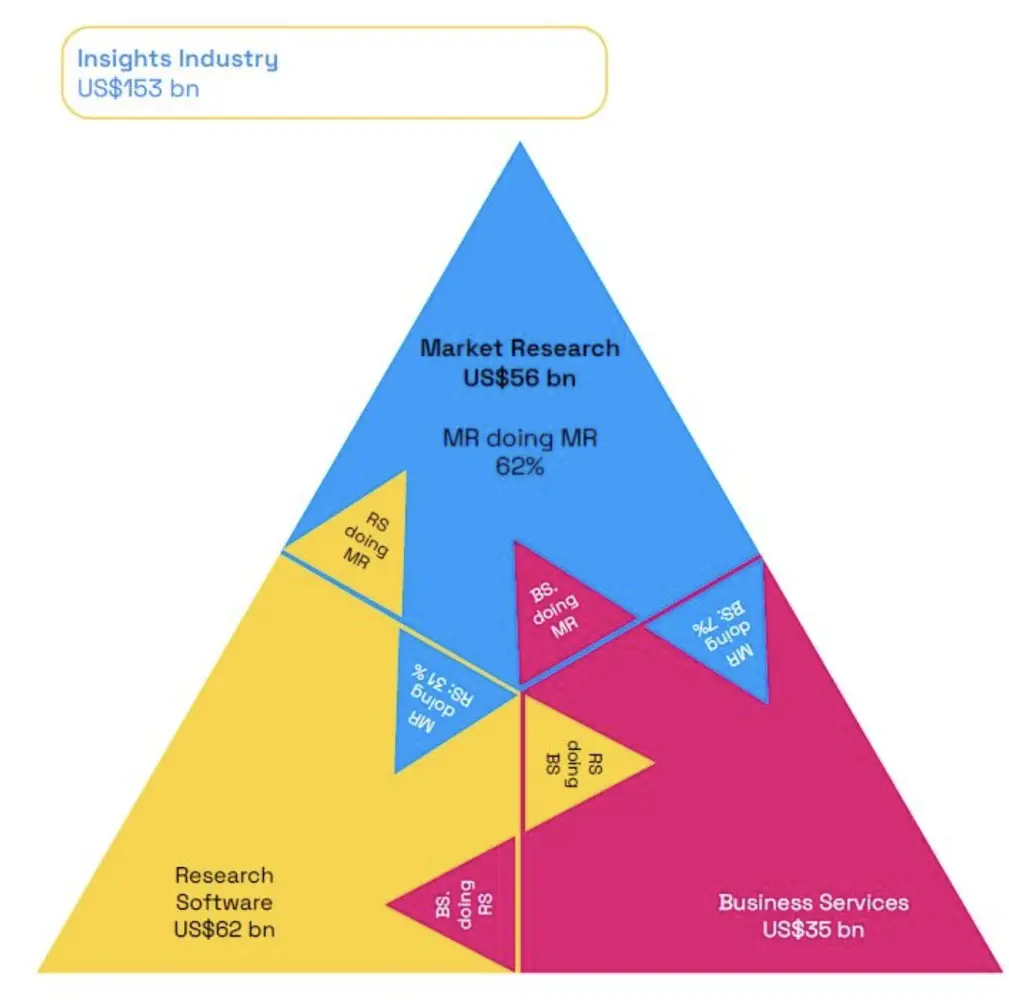
ESOMAR’s 2025 Global Market Research work estimates the global insights industry at more than $150 billion, with research software growing faster than traditional market research services. That does not sound like a profession disappearing. It sounds like a profession being pulled into a new shape.
And that new shape is where the work begins.
We have been here before, just with worse graphics
One thing I think we should remember is that business has, for quite some time, been trying to scale expertise.
Long before today’s AI agents, there were checklists, decision trees, expert systems, knowledge bases, workflow engines, recommendation systems, business rules, and enough process maps to wallpaper a conference room.
The dream was always similar:
Can we take what a good person knows and make it repeatable? Can we help less experienced people make better decisions? Can we reduce errors? Can we make expertise available when the expert is not in the room?
That sounds very modern. It is not.
In the 1960s, DENDRAL helped chemists identify unknown organic molecules from mass spectra. The Computer History Museum describes it as the world’s first expert system, and notes that it shifted AI thinking toward the importance of the knowledge base, not just the inference engine. Edward Feigenbaum put it this way:
“Knowledge is power, and the computer is an amplifier of that power.”
That line still matters.
Because the lesson from expert systems was not simply that computers could reason.
The bigger lesson was that knowledge had to be captured, structured, maintained, challenged, and applied in context.
In the 1970s, MYCIN, another Stanford expert system, was used to diagnose blood infections and recommend treatments. It used about 500 production rules and could explain the reasoning behind its recommendations. Britannica notes that it operated at roughly the same competence level as human specialists in blood infections, and better than general practitioners.
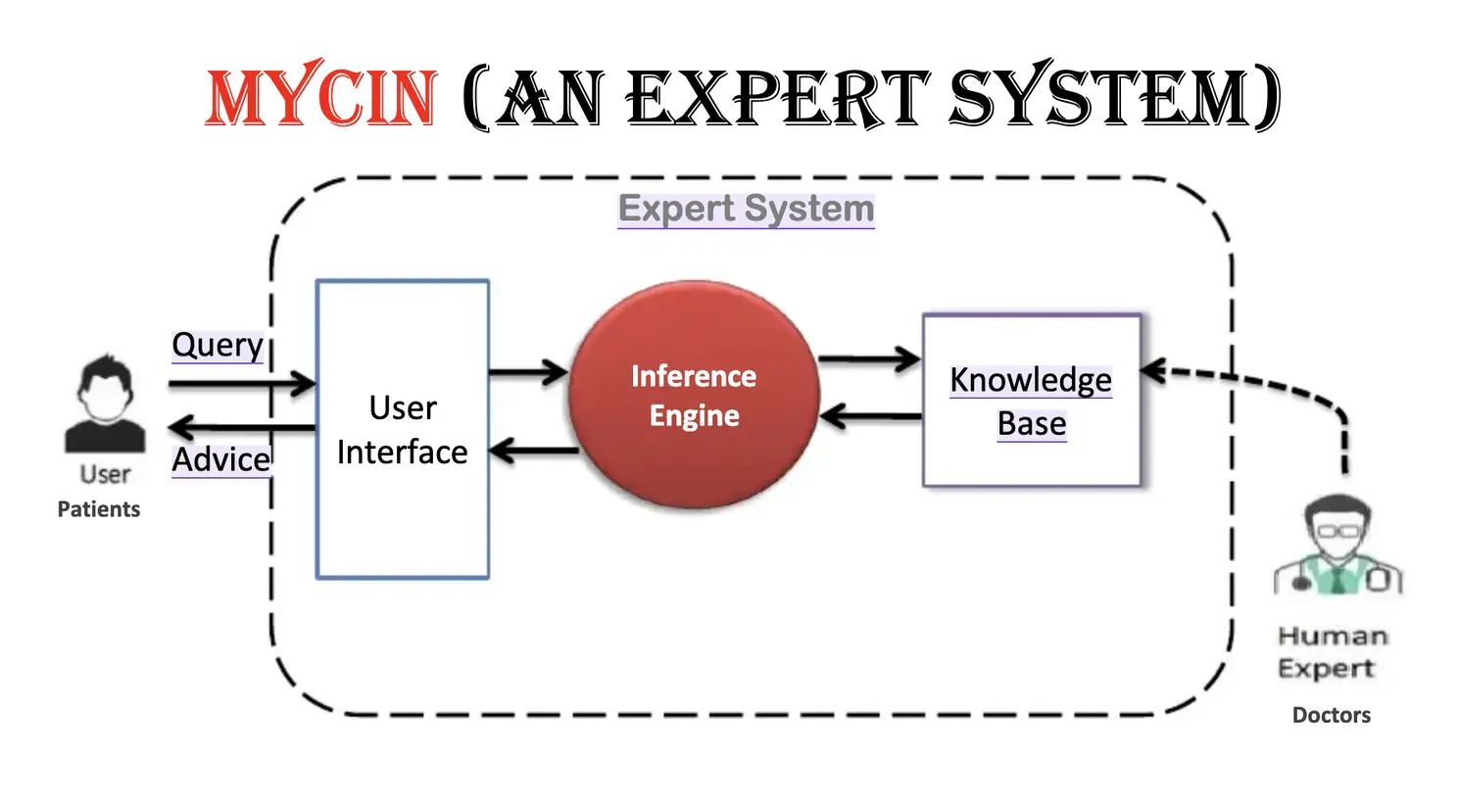
That sounds impressive because it was impressive.
But it also came with a very kindergarten lesson:
Just because someone can explain their answer does not mean you let them run the whole classroom.
MYCIN was powerful in a bounded domain. It had rules. It had a purpose. It had constraints. It had a specific job to do.
Then came business applications like R1/XCON at Digital Equipment Corporation, which configured VAX computer systems. John McDermott’s 1982 paper described R1 as a production system regularly used by DEC’s manufacturing organization to determine necessary modifications to customer orders and to produce diagrams showing how components should be associated.
In other words, it did not “replace business.”
It helped with a specific, complex, error-prone workflow.
And that is where some of today’s AI conversations get a little ahead of themselves.
We keep talking about AI replacing jobs, departments, and industries. But historically, the greatest value has often come from redesigning workflows to better leverage expertise.
The machine handles some repeatable complexity. The human handles judgment, context, meaning, and accountability. The organization learns how to work differently.
That is not magic.
That is management.
A less glamorous word, perhaps. But most real transformation is less “lightning bolt” and more “someone finally cleaned up the supply closet.”
The old bottleneck has a new outfit
The expert systems era also gave us another important lesson: the knowledge acquisition bottleneck.
It turns out that getting expertise out of people’s heads and into a system is hard.
Shocking, I know.
Anyone who has ever asked a client, “So, what decision are we trying to make?” and received a 14-minute answer that somehow included brand tracking, customer churn, innovation, pricing, and “we just need something directional,” already understands the problem.
Knowledge is rarely sitting there in neat little labeled bins.
It is tacit. Messy. Contextual. Sometimes political. Often contradictory. Frequently hiding behind phrases like “Well, it depends.”
Springer’s summary of knowledge acquisition in expert systems describes it as eliciting, analyzing, and interpreting the knowledge that human experts use to solve problems, and often calls it the most serious bottleneck because it requires so much communication between experts and system builders.
That sounds a lot like insights work.
We have always lived in the space between what people say and what they mean.
Between data and decision.
Between the stated objective and the real business anxiety underneath it.
AI does not remove that work. It makes that work more visible.
The companies that succeed with AI agents will not be the ones that simply buy the latest platform and sprinkle it over the org chart like technological parmesan.
They will be the ones who know how to define the problem, structure the work, feed the system good context, evaluate the output, and keep asking whether the answer is useful, true, and decision-ready.
That is why the insights industry has a real opportunity here.
Because our business has never really been data collection.
That was one expression of the business.
Our business is learning.

Lesson one: Use your words
One of the first things we learn in school is to use our words.
Say what you need. Ask for help. Tell the teacher what happened. Try not to communicate entirely through pointing, crying, or hiding behind a bookshelf.
This is also the first lesson in working with AI agents.
AI is not magic. It is communication.
The quality of what we get from AI depends heavily on the clarity of what we give it. Vague instructions create vague outputs. Poor context creates poor judgment. Unclear goals create confident nonsense, which, to be fair, is not exclusive to AI.
In insights, this should be familiar.
A bad research brief yields a less-than-optimal research outcome. A poorly framed business question produces a beautifully designed study that answers the wrong thing. A survey can be perfectly programmed and still be strategically useless.
The same is true with agents.
Do not just say, “Analyze these interviews.”
Say:
What are we trying to learn? What decision will this support? What counts as evidence? What should be treated as signal versus noise? Where should the agent be cautious? What should it not infer? What does a good answer look like?
The prompt is not the work.
The thinking behind the prompt is the work.

Lesson two: Show and tell still works
In kindergarten, show and tell was a big deal.
You brought in a rock, a toy, a souvenir, or occasionally something from home that your parents absolutely did not know you had taken.
The point was simple: examples help people understand.
They help AI agents understand too.
If we want an agent to help write a research brief, code open-ended responses, synthesize interviews, draft a questionnaire, search prior work, or summarize customer feedback, we cannot rely solely on abstract instructions.
We have to show it what good looks like.
Here is a good insight. Here is a weak one. Here is how we talk about evidence. Here is the level of caution we expect. Here is what we mean by “strategic implication.” Here is the difference between a theme and a recommendation.
This is one reason I think the future advantage in insights will not belong only to the firms with the fastest tools.
It will belong to the firms with the best standards.
The best examples.
The best judgment.
The best ability to teach both people and systems how to recognize quality.
Anthropic’s guidance on building effective agents makes a similar practical point from the engineering side: the most successful implementations they have seen use simple, composable patterns rather than overly complex frameworks, and they recommend starting with the simplest solution before adding complexity.
That feels like something a kindergarten teacher would approve of.
Start simple. Make sure it works. Then add glitter.
Actually, maybe do not add glitter. Glitter is forever.
Lesson three: Share your toys
Every classroom has a child who does not want to share.
The red crayon. The blocks. The good scissors.
In business, we have a more sophisticated version of this. We call it “data silos.”
AI agents are only as useful as the context, tools, and permissions they can access. If we ask them to reason across the customer experience but only give them one transcript, two dashboards, and a brand deck from 2019, we should not be surprised when the answer feels thin.
Agents need access to the right toys.
Prior research. Customer feedback. Support tickets. Behavioral data. Brand strategy. Business objectives. Methodological constraints. Decision history.
But sharing does not mean dumping everything into the sandbox and hoping some sort of wisdom shows up, ready for impact.
It means designing access.
What information should the agent use? What should be off limits? What is trusted? What is outdated? What is confidential? What needs human approval?
The redesigned insights function may become less about producing one study at a time and more about building a living learning system.
Not a filing cabinet of old decks.
A usable memory.
A place where the organization can ask, “What do we already know?” before paying to learn it again.
And yes, I say that with love for all of us who have spent parts of our careers creating decks that now live in SharePoint caves, visited only by compliance auditors and ghosts.

Lesson four: Color inside the lines, until it is time to redraw them
Kindergarten classrooms have a lot of lines.
Lines to stand in. Lines to color inside. Lines that define where the rug ends and where chaos begins.
Lines are useful.
AI agents need lines, too.
They need guardrails around privacy, consent, data quality, respondent protection, brand safety, methodology, confidentiality, and appropriate use. They need clear roles. They need review loops. They need boundaries.
We did not hand five-year-olds scissors on day one without supervision, and I think that policy still holds up.
But here is the other part.
Some lines are there because they protect quality.
Other lines are there because “that is how we have always done it.”
The redesign of insights will require us to know the difference.
Do we need every project to follow the same linear process? Do we need every deliverable to be a 72-slide deck? Do we need every study to start from scratch? Do we need qualitative, quantitative, behavioral, and operational data to live in separate neighborhoods forever?
Maybe not.
Maybe agents help us redraw the map.
Not by abandoning rigor.
By applying rigor differently.
The old model often treated insights as a sequence:
Ask. Field. Analyze. Report. Hope someone uses it.
The new model may look more like a loop:
Listen. Learn. Synthesize. Decide. Act. Measure. Ask better questions.
That is not a decline in research.
That is an upgrade in learning.
Lesson five: Take turns
Taking turns is one of the hardest lessons in kindergarten.
Everyone wants the swing. Everyone wants the crayon. Everyone wants to be a line leader, which, I submit, remains one of the first great leadership roles in life.
Working with AI agents also requires taking turns.
The best work is not human or machine.
It is human with machine, in a designed rhythm.
The human frames the problem. The agent explores the material. The human challenges the assumptions. The agent organizes the evidence. The human applies judgment. The agent drafts alternatives. The human decides what matters.
That rhythm matters because AI is very good at producing output.
But output is not the same as insight.
A summary is not an insight. A cluster is not a conclusion. A theme is not a strategy. A fast answer is not automatically a better answer.
This is where the insights industry must be careful not to undersell itself.
If we define our value as “we collect data and make slides,” then yes, AI is coming directly for that.
But if we define our value as helping organizations understand people well enough to make better decisions, then AI becomes a lever.
The work moves upstream.
From project execution to decision clarity. From reporting to sense-making. From method defense to learning design. From “What did the data say?” to “What should we do, and why?”
That is a better seat in the classroom.
Possibly even near the window.
Lesson six: Do not confuse fluent with true
This is where we need to bring in ELIZA.
In the 1960s, Joseph Weizenbaum created ELIZA, a chatbot that could mimic a Rogerian psychotherapist by reflecting user statements back as questions. The program was simple, but users sometimes treated it as though it understood them. Smithsonian notes that Weizenbaum later warned that programs like ELIZA could “induce powerful delusional thinking in quite normal people.”
That lesson may be more relevant now than ever.
AI can sound thoughtful.
AI can sound confident.
AI can sound like it has read every report, attended every meeting, and finally understands why procurement is involved.
But fluency is not necessarily equivalent to truth.
This is one of the great risks in insights.
A well-written wrong answer can travel faster than an awkward true one.
And AI is very good at well-written.
That means our role as insight professionals becomes even more important, not less.
We need to test the output. Check the evidence. Understand the source. Look for missing context. Ask whether the conclusion is warranted. Know when the machine is being helpful and when it is wearing a tiny little consultant costume.
That last part is technical language.
Probably.

Lesson seven: Clean up your own mess
Every classroom has messes.
Paint spills. Blocks scatter. Someone glues something to something that was not requesting glue.
Eventually, the lesson comes:
Clean up your own mess.
AI agents will make mistakes.
Humans using AI agents will make mistakes too.
We will trust them too much in some places and not enough in others. We will use them for tasks they are not ready for. We will underuse them where they could help. We will confuse automation with understanding. We will mistake speed for progress.
The answer is not to avoid AI.
The answer is to build accountability into the workflow.
That means review loops. Audit trails. Source transparency. Methodological standards. Clear escalation points. Human approval where the stakes require it. And a willingness to say, “That output looked good, but it was not good enough.”
The future of insights will not be won by whoever can generate the most content.
It will be won by whoever can create the most trusted learning system.
Trust has always been our currency.
AI raises the bar.
Lesson eight: Ask why
At some point, every child discovers the word “why.”
Why is the sky blue? Why do I have to go to bed? Why can’t I have cookies for breakfast? Why does the dog eat better than I do?
This phase can be exhausting.
It is also the beginning of inquiry.
And inquiry is the heart of insights.
One quote I love, cited in Springer’s expert systems material, is from James Thurber:
“It is better to ask some of the questions than to know all the answers.“
That should be taped above the door of every insights department.
Because in an AI-powered world, answers will be everywhere.
The advantage will belong to the people who ask better questions.
AI can tell us what customers said.
But why did they say it?
AI can identify a pattern.
But why does the pattern matter?
AI can summarize sentiment.
But why is the emotion there?
AI can recommend an action.
But why should the business believe it?
That is where human judgment, empathy, creativity, and commercial understanding matter.
That is where the insights industry earns its future.
Not by being the slow, expensive department that protects old methods.
And not by becoming the fast, cheap department that produces synthetic certainty.
But by becoming the discipline that helps organizations learn responsibly, quickly, and deeply.
The redesign is already underway
We can see the signs.
Greenbook’s 2025 GRIT Business & Innovation Report describes an industry in transition, with technology suppliers surging, service-led firms facing pressure from automation and self-serve tools, and AI moving from experimentation toward integration and measurable performance.
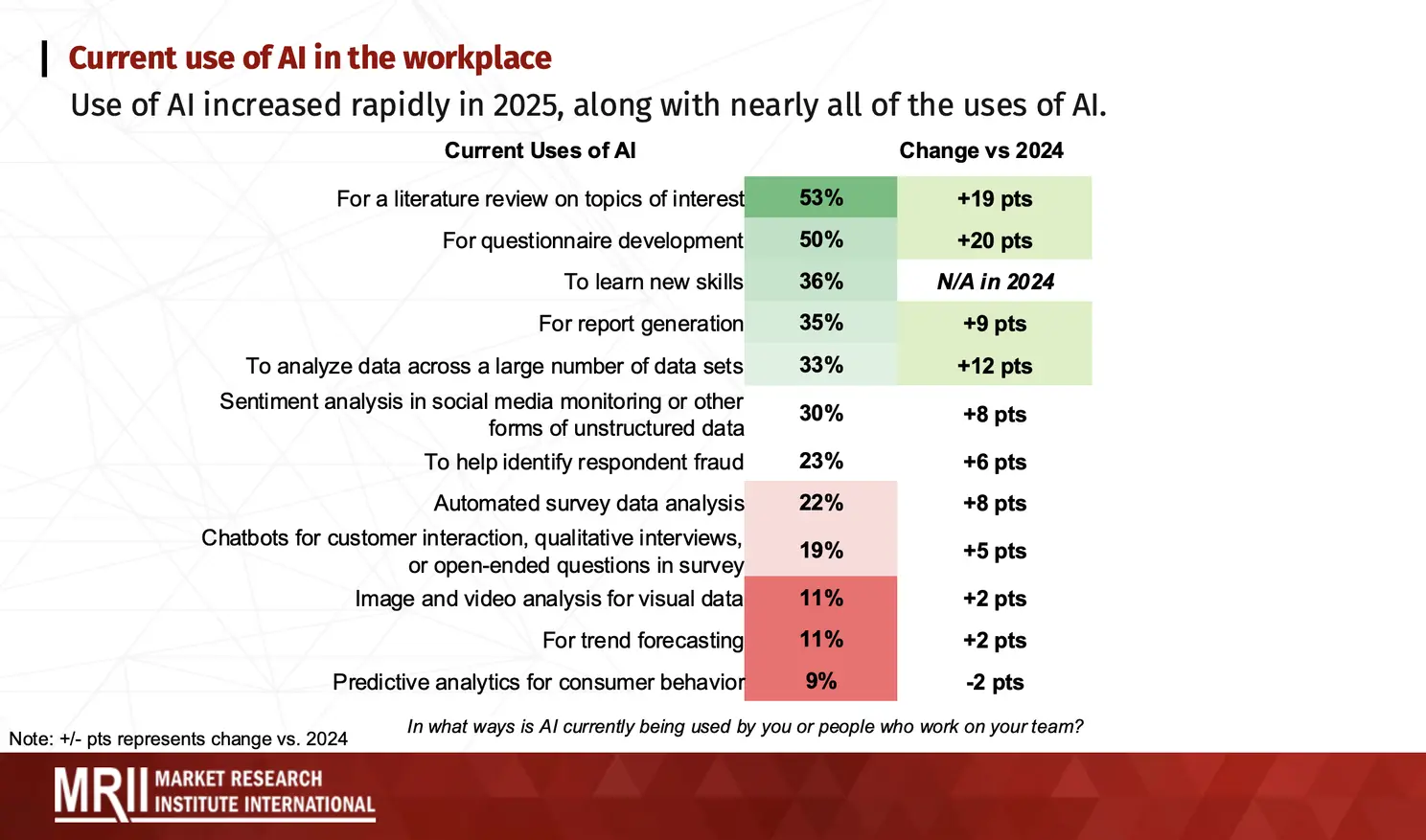
Market Research Institute International’s 2025 AI in Focus study found that 62% of market researchers said they personally, most of their team, or some of their team were using AI, up 23 points from the prior year. It also found optimism about AI’s role, alongside growing concern about job impact.
That feels about right.
Excitement and anxiety.
New shoes and a nervous stomach.
A classroom full of possibilities and no guarantee that we already know the rules.
But that is not a reason to stand in the hallway.
It is a reason to walk in.
The future of insights will not look exactly like the past. It cannot.
Some tasks will be automated. Some workflows will collapse. Some old business models will be challenged. Some methods will be reimagined. Some deliverables will disappear, and frankly, a few of them had it coming.
But the need for understanding people will not disappear.
The need for decision clarity will not disappear.
The need to know why will not disappear.
The insights industry is not in decline.
We are being redesigned around a bigger question:
How do organizations learn in a world where information is abundant, answers are cheap, and judgment is scarce?
That is our classroom now.
A great day for discovering why
So maybe everything I needed to know about working with AI agents really did start in kindergarten.
Use your words. Show what good looks like. Share your context. Take turns. Color inside the lines until you understand which lines need to move. Clean up the messes. Do not confuse confidence with correctness. And above all, keep asking why.
AI agents will change the insights industry.
They already are.
But they will not remove the need for insight.
They will force us to become clearer about what insight really is.
Not data.
Not charts.
Not dashboards.
Not decks.
Insight is disciplined curiosity in service of better decisions.
And that is not going out of style.
We are not watching the end of the insights industry.
We are walking into a new classroom.
And if history has taught us anything, it is this: the tools will keep changing, the workflow will keep evolving, and the people who learn how to learn will have the advantage.
Class is in session.
Let’s discover why.

Let's Work on Your Next Market Research Project
Get started with your next initiative
Follow
OvationMR



Resources
Calculators
Resources
Calculators
Visit Us:
- 101 Avenue of the Americas
- 9th Floor, Suite 908
- New York, NY 10013