
Follow the Money: The Rising AI Backlash
Discovering Why, Volume 12. Subscribe here for more.
Inside this Article…
- Why the next chapter of AI in insights will be shaped less by hype and more by economics, rigor, and trust
- The first wave was about possibility. This wave is about economics.
- The credibility question is where the backlash begins
- Procurement is becoming the new pressure point
- The evidence gap is getting harder to ignore
- Trust is now part of the economic equation
- This is not really an AI backlash. It is a value backlash.
Discovering Why, Vol. 16: To Help Clients Find the Signal Amongst the Noise – Be the Signal in the Noise
Discovering Why, Volume 16. Subscribe here for more.Inside this Article... Be the Signal in the Noise Simplify without making things simplistic Democratize data...
Discovering Why, Vol. 15: Everything I Needed to Know About Working with AI Agents I Learned in Kindergarten
Discovering Why, Volume 15. Subscribe here for more.Inside this Article... The insights industry is not in decline. It is in redesign. We have been here before,...
Discovering Why, Vol. 14: The Chronically Underserved Long Tail of Insights
Discovering Why, Volume 14. Subscribe here for more.Inside this Article... Introduction The Hidden Growth Trap When Infrastructure Becomes Drag The Better...
Discovering Why, Vol. 13: Probability, Statistics, and the Human Equation
Discovering Why, Volume 13. Subscribe here for more.Inside this Article... What I Learned at the “Probability & Statistics” Table The Formula Is Only the...
Why the next chapter of AI in insights will be shaped less by hype and more by economics, rigor, and trust
For the past two years, the AI story in insights has mostly been told as a story of progress.
Faster work. Lower cost. More scale. Less friction.
And some of that is absolutely true. At OvationMR, AI is already helping our research teams compress timelines, reduce manual effort, and do more with less. Qualtrics, who has a big bet on the AI’s future relevance, reported in a global survey of 3,000 insight practitioners that 71% of market researchers believe synthetic responses will make up more than half of data collection within three years. Just as importantly, Qualtrics tied that expectation directly to budget pressure, privacy concerns, data scarcity, and survey fatigue. The same report found that teams using more advanced AI and synthetic personas were also more likely to report growing budgets and greater influence inside their organizations.

That should get everyone’s attention.
Because when an industry sees a path to faster delivery and lower cost, money moves.
Usually, before standards do. Almost always, before governance does. And almost guaranteed, prior to when the industry fully sorts out what is being improved, replaced, and what should never be confused in the first place.
That is why I think we are entering a new phase.
Not an anti-AI phase.
A more skeptical phase. A more disciplined phase. A phase where buyers, suppliers, and decision-makers are beginning to ask a more serious question: are we using AI to improve research, or are we using AI to imitate research at a lower cost?
That is a very different conversation.
And if you want to understand why the tone is shifting, follow the money.

The first wave was about possibility. This wave is about economics.
The first wave of AI enthusiasm was fueled by imagination. Suddenly, we could picture automated moderation, instant analysis, synthetic audiences, AI personas, faster ideation, faster segmentation, and faster reporting. The potential was real, so the excitement was real.
But possibility alone does not move markets. Economics does.
Synthetic respondents are attractive because they appear to solve several expensive problems at once. They reduce the time and cost of recruiting. They sidestep some privacy and access constraints. They promise scale on demand. They answer the relentless pressure to do more research with fewer resources. That is not just a methodological appeal. It is a financial one. And that is why this shift has happened so quickly. The business case often arrives before the validation case.
For suppliers, the appeal is more throughput and potentially better margins. For buyers, the appeal is lower cost and faster answers. For both, the temptation is the same: if the output looks plausible enough, maybe that is good enough.
But that is exactly where backlash begins.
Because sooner or later, someone asks the question that cuts through all the hype: what exactly are we buying?
The credibility question is where the backlash begins
Ray Poynter’s recent conference reflection is so useful here.
His report from the CSDI 2026 workshop in Vienna highlights a striking reality. Many of the highest-quality studies discussed there, including major European and other cross-national programs, are still conducted face-to-face. Yet those approaches are becoming harder to sustain because of rising costs, falling response rates, and questionnaire lengths that can stretch to an hour.
His key takeaway gets right to the heart of the issue: how do we preserve rigorous, comparable survey evidence while moving away from expensive and increasingly fragile traditional fieldwork models toward postal, online, and mixed-mode approaches?
That is the tension.
The industry is not moving away from face-to-face because rigor no longer matters. It is moving away because rigor is getting harder and more expensive to sustain. Cost pressure is shaping methodology choices. But the standard has not changed. Quality, comparability, and representativeness are still the goals.
And that is why this moment matters so much.
The backlash is not simply about AI. It is about the idea that cost reduction somehow eliminates the underlying tradeoff. It does not. It simply shifts the tradeoff from visible cost to less visible risk.
Procurement is becoming the new pressure point
One of the clearest signs that the market is changing is not outrage. It is procurement.
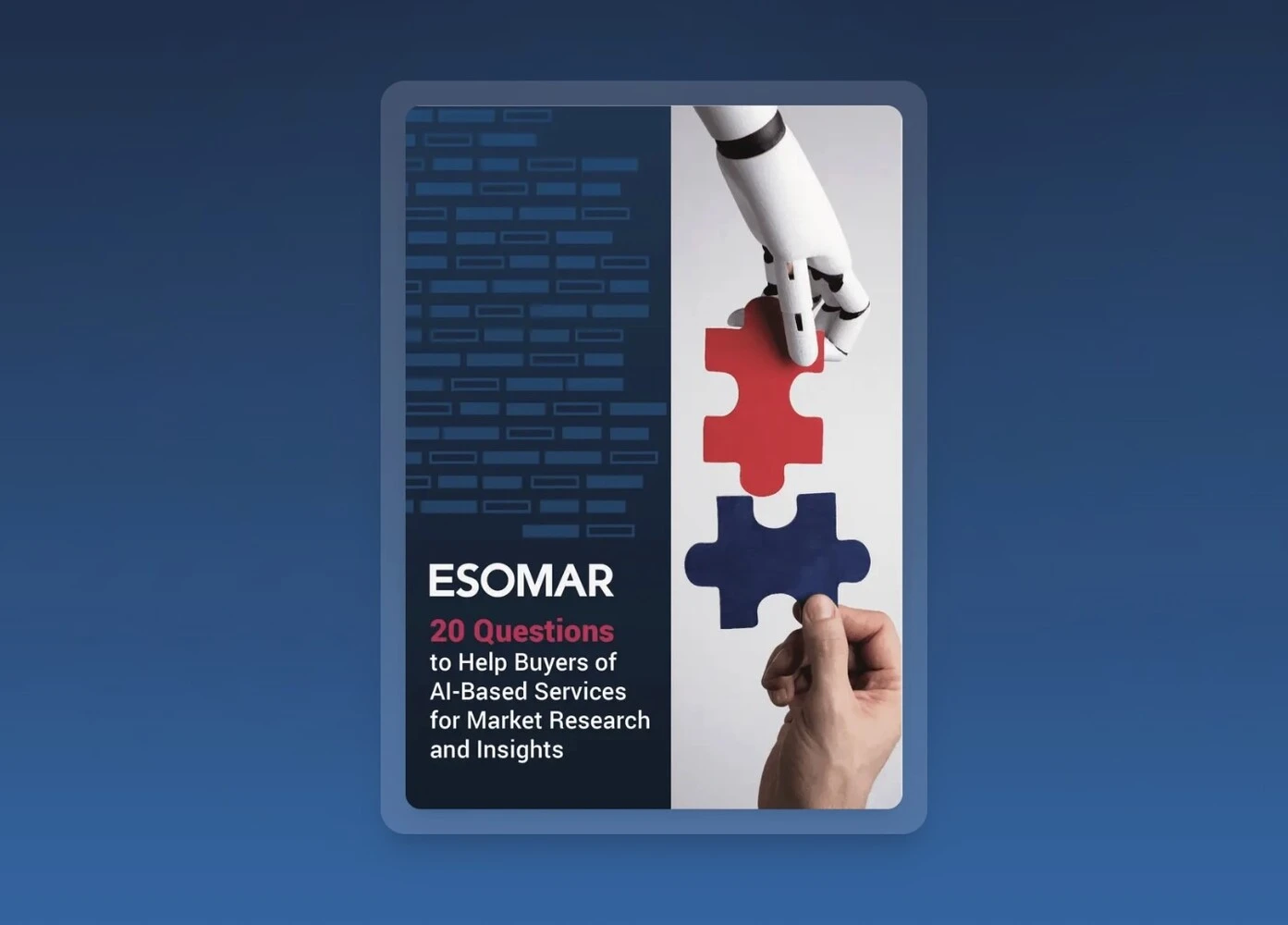
ESOMAR’s “20 Questions to Help Buyers of AI-Based Services” is a pretty powerful signal that the industry recognizes that buyers now need a more disciplined way to evaluate AI claims. The checklist is designed specifically to help research and insights buyers assess AI-based services through questions about transparency, governance, validation, limitations, privacy, data lineage, and human oversight. In other words, the market is beginning to demand proof, not just promises.
This is how trend shifts usually begin.
Not with a dramatic rejection. With tougher questions.
Not with a hard no. With “show me.”
Not with ideology. With due diligence.
And that is why I think this shift is real. Buyers still want speed. They still want productivity. They still want lower cost. But they are becoming less willing to accept AI claims without clearer evidence of validity and fit for purpose.
The evidence gap is getting harder to ignore
That caution is also being reinforced by the research.
A peer-reviewed paper in the University of Cambridge’s, Political Analysis, tested whether large language models could serve as synthetic replacements for human survey data. The authors found that while average outputs could sometimes look similar to human survey averages, the deeper statistical relationships often broke down. They reported that 48% of the coefficients estimated from ChatGPT-generated responses differed significantly from human survey results, and in 32% of those mismatches, the sign reversed. They also found reproducibility concerns because results changed when the underlying model changed.
That is not a footnote.
That is a warning label.
It tells us that plausible is not the same as reliable. And once money starts flowing toward faster, cheaper substitutes, reliability becomes the question that matters most. Because the hidden cost of low-cost certainty is poor decision-making dressed up as insight.
Trust is now part of the economic equation
J. Walker Smith has also been pointing to the trust problem around AI. In recent commentary, he noted that trust in AI remains low and warned that AI is “dumbing down” marketing, not in a superficial sense, but in the practical sense of producing skewed evidence. That phrase matters. Skewed evidence is exactly what markets eventually punish, especially when important decisions are at stake.
And then there is Nate Silver, who said the quiet part out loud.
On X, he recently posted that using AI “respondents” is “literally just making up fake data.” He went further, saying firms that “make up” data are “permabanned” from Silver Bulletin averages and forecasts.
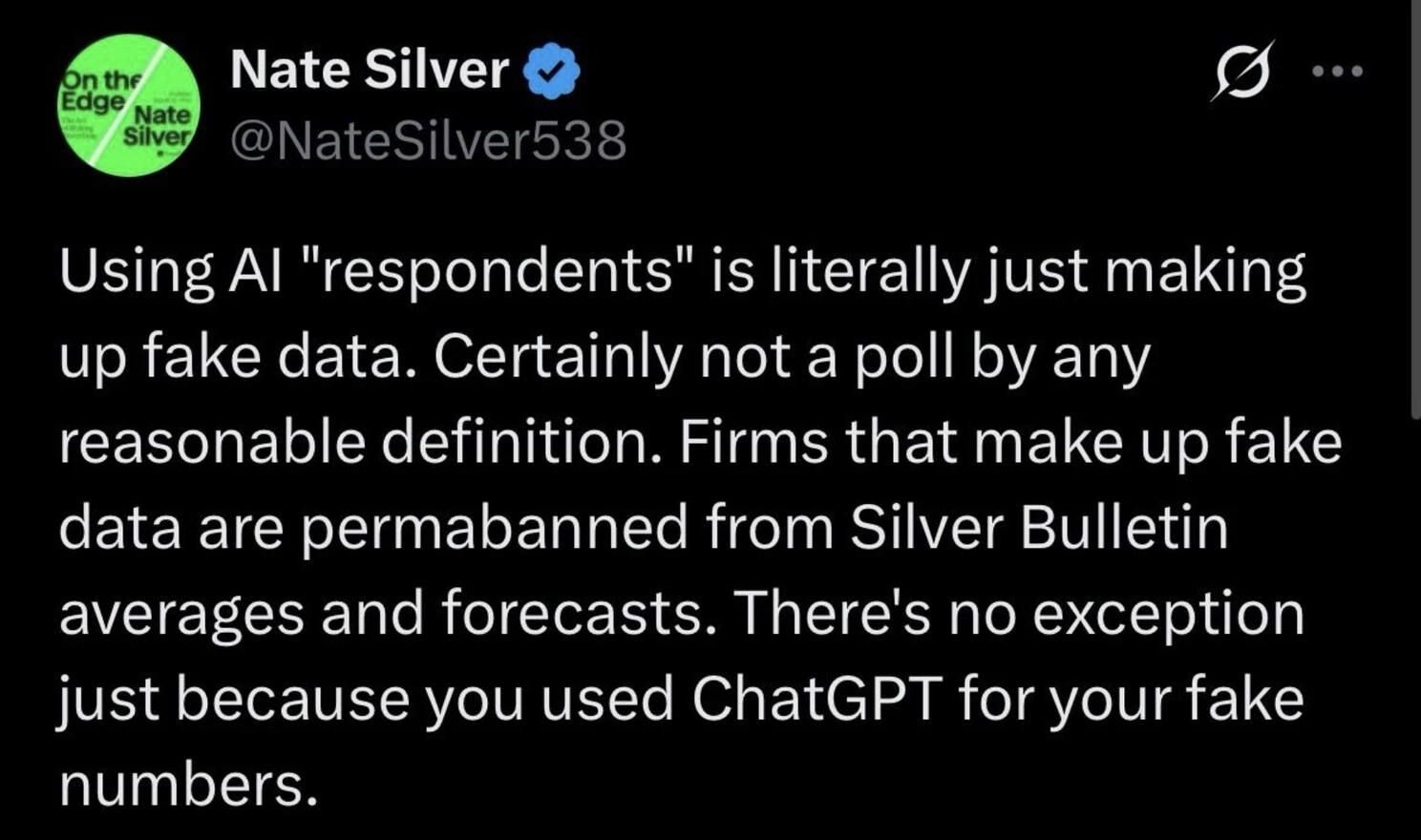
That language is sharp. Maybe sharper than many in our industry would use. But that is precisely why it matters.
It signals that in one of the most credibility-sensitive corners of the data world, the distinction between modeled output and observed evidence still matters. A lot.
And once credibility markets begin drawing harder lines, the economics start to change.
A low-cost method stops looking attractive if it creates reputational risk. It stops looking efficient if the numbers cannot be defended. It stops looking innovative if clients begin to wonder whether they are buying learning or just getting something that sounds like learning.
This is not really an AI backlash. It is a value backlash.
That is why I do not think this is best described as an AI backlash.
I think it is a value backlash.
A backlash against confusing cheaper with better.
A backlash against replacing observation with simulation and pretending the distinction no longer matters.
A backlash against monetizing shortcuts before proving they deserve trust.
A more mature market will still use AI. Probably more of it, not less. But the winners will use it differently. They will use AI to accelerate discovery, sharpen thinking, improve workflows, and reduce waste. They will not confuse that with “manufacturing” reality.
The market rewarded speed.
Now it is starting to reprice credibility.
And that may be the healthiest shift of all.
Because in the end, the best work in insights has never just been about getting to answers faster.
It has been about discovering why.

Let's Work on Your Next Market Research Project
Get started with your next initiative
Follow
OvationMR



Resources
Calculators
Resources
Calculators
Visit Us:
- 101 Avenue of the Americas
- 9th Floor, Suite 908
- New York, NY 10013